



I spoke to Roger Ballen about his photographic journey into the subconscious.
What’s a Rich Text element?
The rich text element allows you to create and format headings, paragraphs, blockquotes, images, and video all in one place instead of having to add and format them individually. Just double-click and easily create content.
Static and dynamic content editing
A rich text element can be used with static or dynamic content. For static content, just drop it into any page and begin editing. For dynamic content, add a rich text field to any collection and then connect a rich text element to that field in the settings panel. Voila!
How to customize formatting for each rich text
Headings, paragraphs, blockquotes, figures, images, and figure captions can all be styled after a class is added to the rich text element using the "When inside of" nested selector system.

Roger Ballen is an American photographer who has lived and worked in South Africa for the past 50 years. He first became famous for Dorps and Platteland, two bodies of work which explored the margins of life in white South Africa during the dying days of apartheid. As South Africa became a new and very different country, Roger's started working with assembled photographs that use surrealism as a way to document the interiors of his own mind. In this wide-ranging interview, I speak to Roger about his photographic journey and the places it has taken him. I hope you enjoy the conversation. And if you like this podcast...
PM: Hi Roger, thank you so much for talking to me again.
RB: Great pleasure, and I'm happy to speak and can't wait to listen to the questions.
PM: I'm also looking very forward to this. So I'm just going to fire ahead. My first question relates to Spirits and Spaces, your new book and exhibition, which, for the first time, is in colour. I know you've done some polaroid work in colour before, but this is your first major body of work rendered in colour. Do you find it liberating to work with colour, and do think that you'll continue to work with colour photography?
RB: I'm still working in colour. It wasn't a very big transition for me. In a way, when I started taking colour pictures, the colours felt like tones almost. And the colour that I'm sort of known for, or what my aesthetic and colour is, is a monochromatic colour. So it's not a bright, bright colour. So when I'm working with the colour, it almost feels like I'm working with black and white tones. So it was such an easy transition – I couldn't even believe it. I hardly knew that there was any difference between what I was doing, except, at the end, the pictures were in colour. And then , because it was digital – up to 2016 when I did black and white everything was filmed – and this is a digital camera. So when I take the pictures back to my centre and look at the pictures on the computer, I'm able to create different saturation levels. And usually we bring the colour down. It sort of feels like half black-and-white and half colour.
PM: How does the editing process work for you digitally compared to physically printing?
RB: Look, I think digital has a lot of advantages. I probably would get hung by a few people for saying this, but it does have most of the advantages. Firstly, you can see the picture, so it gives you a better idea of what you're doing – it's like a Polaroid. Secondly, you know, I work with animals, and I always make a joke, you know, “I'm ready, here's the bird, here's the bird”. And he's just about ready and flies one shot. Second shot, oh no, I've run out of film!
So it allows you to create and get moments. Photography is a lot about moments. And sometimes, I was shooting in square format with 12 pictures on a roll. It was very easy to run out of film, and then it takes time to fix the film and get going again. And sometimes the picture just disappears. And when you bring the picture back, it's a lot easier to work on the picture, you know, than working in a dark room.
It's a much easier process, and it's a lot less expensive as well. So I can see all the reasons why people moved to digital – it's clear to me. I think, if you're going to do film, black and white film – and colour is even more difficult to process, you really have to be a terrific professional printer. It's very difficult to make good silver prints. It's very, very difficult. And it's not as difficult to make good pigment prints or inkjet prints. And so a lot of people gave up on this because, even though they did film, they just couldn't make decent prints.
PM: Yeah, Has your relationship with your printer changed at all as a result?
RB: No, I do all the colour and exhibition black and white prints from my museum here. So we do everything. We have all the machines and we have a technician doing this. It's much better that way because I'm here to watch the thing throughout the process, from taking the picture to looking at it on the screen to playing around with it on the printer. So it's a much more effective way of working than giving it to somebody else to do.
PM: Do you take more images (with a digital camera)?
RB: You would take more, you definitely would take more than with film. There's absolutely no doubt. You know, you can push the button and shoot 10 pictures within 10 seconds, and then shoot another 10 and another 10, so you do take a lot more pictures.
PM: Yeah.
RB: And so I think your chances of getting the hit – because photography is really about catching a moment – is much greater with a digital camera, much, much greater. And what's interesting in digital, and in my black and white over the last over 50 years now – almost in my entire career – whether it's been on digital or whether it's been on film, I've rarely gotten two great pictures from the same scene, almost never. And it tells you a lot about the philosophy of time, that everything is different, everything's different. You know, it could be just a blink, it could be how somebody breathed, turns, how I move the camera, anything, could be anything. But it just tells you that every moment in time is different.
PM: Yeah. Does the editing, the selection process, take longer? Because I mean, I get very carried away, you know, I'll probably take too many images and I can spend way more time selecting an image, you know, choosing the one that resonates perfectly, then actually taking the photographs.
RB: I don't think so, you know, it's like walking in nature or something, something jumps out at you, you know, something's way ahead. It's true, even in art, you know, there's certain people who are just a step ahead. And it's the same with these pictures, you know, there's one that's just a step ahead. And so you notice it. I think the hard part is when nothing is a step ahead and they're all sort of – none of my pictures are mediocre – but are better than mediocre, and you can't find the star. That's more of a difficult problem than finding the picture that is a star. The star stands out.
PM: Yeah, yeah, that's generally my experience as well. I'll take 20 and usually it's either the first one or the last one, but I usually do know which one was the shot.
RB: Usually the last one, because that's when you quit.
PM: Yeah, yeah, yeah. I had to get really good at introducing my videos and I'm very comfortable, you know, talking, you know, just casually, but having to do a recited performance was really a challenge for me and it was always the last one that was the best.
RB: You know, there are definitely surprises. I remember Diane Arbus's famous quote, "The pictures are never better, never worse than I thought".
PM: Yeah.
RB: It's impossible to predict. There's so many pieces coming together. You have to look at the picture. But again, the advantage of the digital is you can look at the picture and say, "geez, I'm getting there", or "I got it", or "I think I got it". Whereas with black and white film, you don't know that. So a lot of times you stop, and you didn't get it. And obviously there are good things about it, it's more precious, so you're more selective. That's something that could be true.
And I always say, you know, I used a 6x6 camera, and when you took the picture it was like against your stomach almost, so it was like part of your body. And the camera I have now is on a tripod, usually, or it's up against my eye. So, it's, you know, it's like phenomenologically, it was sort of more associated with the camera. It felt more like me than the camera does today.
PM: Yeah, yeah, sure. I understand that. Does it still feel like magic?
RB: It is magic. It is a form of magic. It is, because it's freezing reality. And I guess the fundamental question is...is every moment of your life stored in your brain cell. Most of those moments can't be materialised. You can't take a brain cell and materialise it physically. You can have a memory, but it's just a memory of passing, fleeting things. It's not something physical. So this is a physical memory that the brain can't by itself produce.
PM: Yeah. And, then the act of taking that photograph also does something neurologically, changes the way we remember that moment. I remember nearly every time I actually did the click, whereas I wouldn't have necessarily remembered that moment otherwise.
RB: No, you're absolutely right. That's why people like photography. It's the most fundamental reason – it preserves a memory. And the brain has a subjectivity to it, and it's inundated with every second of your life. So, it's hard to know what comes first, what comes last, why, where, how. It's all confused. It's almost like a dream.
PM: Yeah, for me, photographs are still pure magic. And it's amazing how that feeling of "wow", looking at an image that you took or that somebody else took, that just, you know, does something. It's extraordinary.
RB: If they do it seriously, it's like a diary, almost; it's like a way of writing a diary, that's what it is. I think that's one really positive thing when you've done it for so long ,like I have, that you look back, and this was my life. And these are my most physical memories. There's something more there than just a memory that comes to me in one second and goes away in one second. So there's some duplication of factualisation of the passage of time of Roger Ballen.
It's a very eerie feeling though. Because, I'm like 76; I'm looking back at my career, still taking a lot of pictures – I'm always working, all the time – but you look at the picture, "Jeez, is that 30 years ago? Oh, 25 years ago. It feels like nothing. I can't believe it". So it does create all sorts of mental, cognitive dissonance inside your head about the nature of how time went by.
PM: Yeah. Sometimes you are in your own photographs occasionally or there are documents of you taking photographs. How is it to see yourself as a young man? I was looking at images of you from the early 2000s when I first met you. I'm astounded at how much time has passed since then. Do you get a sense of strangeness looking at yourself?
RB: Yeah, it's very strange. Very strange. That's the most strange thing I think of human existence is the passage of time. It's inconceivable. It's a force that you can't put your finger on. We obviously are products of it, but we don't have control of it. You're biologically determined in a way. So it is strange and eerie, and can be very motivating. I think it can be very...I think that's, I guess, one of the reasons if you're serious about what you're doing in photography as an art, it's a way of preserving time and factualising your life in some way or another, making some sense of it. Or trying to make sense of it. Well, that's what I do.
PM: So I have a question that's very much related that I was gonna ask you later, but it's just like I need to ask it now. Looking through your broad body of work, there is a profound feeling of timelessness, a kind of absence of now. And by that, I mean both the contemporary moment, the contemporary world, and also just the notion of a sustained moment. It feels a little like time has gone on a holiday, but of course it's also a record of that calibrated moment in time. Do you try to capture images that feel out of time, that feel timeless?
RB: You're making a very important point in art. That's what good art should be. It should have a sense of timelessness. It should have that element in it. It shouldn't be something that just...disappears, here and now. It should have that sense of saying something that never goes away in terms of the human experience. That's a very important part in distinguishing criteria for me, I mean there's so many criteria in art, but for me it's a very important criteria that the work separates itself from time, the particular cultural political time, and it says something about the human psychological experience of existence.
PM: Do you think that is further exaggerated or just made stronger by the fact that you are trying to represent aspects of the subconscious?
RB: Yeah, I don't really...Look, the subconscious mind is also a complicated definition. I mean, the subconscious mind, where is it? Where is it? It's a...it's a brain cell, everything is a brain cell. And the brain in the conscious mind and the so called subconscious mind could be in the same brain cell, who knows what, it's a very arbitrary word. And so they work together in a harmonious way. And one takes over from the other, perhaps, but everything is...It's all mixed up and ultimately the meaning of the work for me, the unconscious mind is and the silent mind is a very unattainable way of talking about it. It's an obscure relationship to yourself and the rest of the world. And for me, those definitions of how you feel towards the subconscious and the subconscious could be a place of the dreams, it could be the place of the nonverbal world, the instinctual world. That sense of the subconscious is the same sense I'm trying to mimic in the pictures. And if I get there, then I've created something that is powerful and enigmatic and has lasting power, and it has this sort of archetypal subconscious sensibility to it. And there's no planning, there's no way of saying "I'm going to do step one, two, three, four, five." It doesn't work that way. It doesn't work that way. There are thousands of steps and decades and decades and decades of work to be able to cross that river.
PM: Yeah, I mean, maybe when we talk about the subconscious, we're already just talking about the mind. And just a tiny portion of our mind is the egoic top layer that we have access to. And the rest is this vast mass...
RB: It's primal.It's primal, like an animal.
PM: Yeah, and highly intelligent, that primality.
RB: Well, mosquitoes are intelligent, everything living on the planet is intelligent. We forget that mosquitoes are intelligent, a cockroach is intelligent, everything's intelligent. It has to have an intelligence to survive.
PM: Yeah. And I find a lot of people put their ego as the most intelligent layer of that. But, personally for me, that is so obviously not the truth. My body, the internal operations, you know, the calculations my brain does at the back, they are all way more intelligent than my little ego voice.
So, I want to ask you a little bit more about colour, because for me, the presence of colour in your work makes it both more real and also more unreal. So, given your concern around what I would call psychological realism, how important is it to you that the spaces that your images effectively evoke a physical space? How important is realism?
RB: Well, see, in photography, 99 % of time, you can't get away from the concept of realism. If photography goes too far away from realism, it usually doesn't work. I'm not saying all the time. Photography is based on a viewpoint of the real, the physical.
So, if I was a painter and I had a dream last night, I can try to paint the dream. But if I'm a photographer, I've got to find physical objects in the world to somehow or another mimic that dream in one way or another. And so this is what makes photography complex as an art form, because to get to that point that you're talking about, you have to work in physical reality to get there, then capture it through a physical machine called a camera. And this is not something that's necessarily easily accomplished. That's why for most people in photography, it's documentary. Go and take a picture of a birthday cake or a riot somewhere, or a war. But most of these pictures don't have the ability to transform the subconscious. They're factual. They're factual – the mind already has contended with the issues of war and issues of birthday cakes. But to challenge its state of being, that's a big step forward.
And I think, most importantly, it has to challenge my state of being. That's the whole point of what I'm doing. That's step one. I can't get in anybody else's head. I can't, I can't, I can't, period. So it has to challenge me. For example, yesterday, I did a picture, and my mind has been trying to figure out the meaning of this picture, going round and round and round. And it's a coherent meaning and it's enigmatic. And I know that, and because of that, I know it's a very, very good photograph.
PM: There's something – I can't remember where this came from – but you mentioned that sometimes you only truly work out the meaning of your own images years later. Am I remembering correctly?
RB: You're right, but the meaning is still multi-dimensional if it's a good picture. Now we have this level, you know, like if we talk 30 years ago, I can figure out the meaning. But if I'm now talking about the last, like, 20 years and look at some of those pictures, I don't get there. I won't get there. They're not made to get there. You won't get there. The ones that start to incorporate the drawings in the pictures, that's sort of a very important boundary line in my work, because the drawings bring another sense of aesthetic to the pictures. And it's very hard to understand the relationship of the drawings to the rest of the picture.
PM: Yeah. I mean, I do think we overstate the centrality of meaning and plot and narrative when there's so many other things going on. When I watch a movie, I probably remember the texture and emotional feelings far more than I remember the actor's names or the story or what actually happened.
RB: Meaning is...there's non-verbal meaning and there's verbal meaning.You know, we too, as you said, this front part of the brain is geared towards rational thinking, but most of the brain is dealing with the silent world, whether it's figuring out how to deal with the problems of the heart, the health, the immune system, the sleep, the food, and trying to figure out, you know, how to survive on this planet, and try to figure out something to do with its own identity and its relationship to life and death.
PM: These vessels we walk around in are extraordinary.
RB: It's a problem we live in, this so-called illusion of science and AI, but it doesn't solve any problems.
PM: I often just look at my hand, and the extraordinary things it can do, and the incredible sensitivity – I can feel the stain on a desk if I'm trying to clean or something. I'm just continually amazed by the incredible...
RB: It's enigmatic, it's enigmatic, that's what I'm saying, you can't, you have no ability to materialise anything here. What is the consciousness that tells the hand to move? How does that actually happen? Where did the idea come from? Did the idea come first or did the action come first? So, there are all these very complicated questions which you can't answer. At the end of the day maybe it's not...maybe even the whole thing is an illusion.
PM: Yeah, yeah. mean, there is a sense of which it's, you this is a rabbit hole, know, a giant wormhole. But, clearly, our consciousness operates on some basic illusory level in order to make sense of the world. I think science kind of shows it.
RB: Maybe, maybe, maybe not. I've gotten to the point....I don't know. I wouldn't necessarily even say that. What do you mean by the world?
PM: Exactly, but I mean...I mean, just the fact that we know...
RB: It's just a brain cell.If you logically you're just a brain cell, but maybe you're not even that, so who knows. It is very complicated. And this is why I'm saying you're now on another reality train now.
PM: Yeah.
RB:Now you're going into a dark tunnel here.
PM: Exactly.
RB: That's a good place to be. Because that's the challenging question really. It's not whether there's going to be a peace deal in Iran and between Iran and America tomorrow. That's another question, another type of question.
PM: Yeah. Exactly. So you've been living and working in South Africa for most of your adult life?
RB: Since 1982.
PM: Okay, so since your early 30s.
RB: Yeah.
PM: So, from my perspective – and I don't know how this will resonate with you – but I find there are remarkable parallels between the physical and social landscapes of America and South Africa, especially towards the margins. Do you agree with me and, if so, was there something that attracted you to making art in South Africa? Or are the differences more important?




LESS
Roger Ballen is an American photographer who has lived and worked in South Africa for the past 50 years. He first became famous for Dorps and Platteland, two bodies of work which explored the margins of life in white South Africa during the dying days of apartheid. As South Africa became a new and very different country, Roger's started working with assembled photographs that use surrealism as a way to document the interiors of his own mind. In this wide-ranging interview, I speak to Roger about his photographic journey and the places it has taken him. I hope you enjoy the conversation. And if you like this podcast...
PM: Hi Roger, thank you so much for talking to me again.
RB: Great pleasure, and I'm happy to speak and can't wait to listen to the questions.
PM: I'm also looking very forward to this. So I'm just going to fire ahead. My first question relates to Spirits and Spaces, your new book and exhibition, which, for the first time, is in colour. I know you've done some polaroid work in colour before, but this is your first major body of work rendered in colour. Do you find it liberating to work with colour, and do think that you'll continue to work with colour photography?
RB: I'm still working in colour. It wasn't a very big transition for me. In a way, when I started taking colour pictures, the colours felt like tones almost. And the colour that I'm sort of known for, or what my aesthetic and colour is, is a monochromatic colour. So it's not a bright, bright colour. So when I'm working with the colour, it almost feels like I'm working with black and white tones. So it was such an easy transition – I couldn't even believe it. I hardly knew that there was any difference between what I was doing, except, at the end, the pictures were in colour. And then , because it was digital – up to 2016 when I did black and white everything was filmed – and this is a digital camera. So when I take the pictures back to my centre and look at the pictures on the computer, I'm able to create different saturation levels. And usually we bring the colour down. It sort of feels like half black-and-white and half colour.
PM: How does the editing process work for you digitally compared to physically printing?
RB: Look, I think digital has a lot of advantages. I probably would get hung by a few people for saying this, but it does have most of the advantages. Firstly, you can see the picture, so it gives you a better idea of what you're doing – it's like a Polaroid. Secondly, you know, I work with animals, and I always make a joke, you know, “I'm ready, here's the bird, here's the bird”. And he's just about ready and flies one shot. Second shot, oh no, I've run out of film!
So it allows you to create and get moments. Photography is a lot about moments. And sometimes, I was shooting in square format with 12 pictures on a roll. It was very easy to run out of film, and then it takes time to fix the film and get going again. And sometimes the picture just disappears. And when you bring the picture back, it's a lot easier to work on the picture, you know, than working in a dark room.
It's a much easier process, and it's a lot less expensive as well. So I can see all the reasons why people moved to digital – it's clear to me. I think, if you're going to do film, black and white film – and colour is even more difficult to process, you really have to be a terrific professional printer. It's very difficult to make good silver prints. It's very, very difficult. And it's not as difficult to make good pigment prints or inkjet prints. And so a lot of people gave up on this because, even though they did film, they just couldn't make decent prints.
PM: Yeah, Has your relationship with your printer changed at all as a result?
RB: No, I do all the colour and exhibition black and white prints from my museum here. So we do everything. We have all the machines and we have a technician doing this. It's much better that way because I'm here to watch the thing throughout the process, from taking the picture to looking at it on the screen to playing around with it on the printer. So it's a much more effective way of working than giving it to somebody else to do.
PM: Do you take more images (with a digital camera)?
RB: You would take more, you definitely would take more than with film. There's absolutely no doubt. You know, you can push the button and shoot 10 pictures within 10 seconds, and then shoot another 10 and another 10, so you do take a lot more pictures.
PM: Yeah.
RB: And so I think your chances of getting the hit – because photography is really about catching a moment – is much greater with a digital camera, much, much greater. And what's interesting in digital, and in my black and white over the last over 50 years now – almost in my entire career – whether it's been on digital or whether it's been on film, I've rarely gotten two great pictures from the same scene, almost never. And it tells you a lot about the philosophy of time, that everything is different, everything's different. You know, it could be just a blink, it could be how somebody breathed, turns, how I move the camera, anything, could be anything. But it just tells you that every moment in time is different.
PM: Yeah. Does the editing, the selection process, take longer? Because I mean, I get very carried away, you know, I'll probably take too many images and I can spend way more time selecting an image, you know, choosing the one that resonates perfectly, then actually taking the photographs.
RB: I don't think so, you know, it's like walking in nature or something, something jumps out at you, you know, something's way ahead. It's true, even in art, you know, there's certain people who are just a step ahead. And it's the same with these pictures, you know, there's one that's just a step ahead. And so you notice it. I think the hard part is when nothing is a step ahead and they're all sort of – none of my pictures are mediocre – but are better than mediocre, and you can't find the star. That's more of a difficult problem than finding the picture that is a star. The star stands out.
PM: Yeah, yeah, that's generally my experience as well. I'll take 20 and usually it's either the first one or the last one, but I usually do know which one was the shot.
RB: Usually the last one, because that's when you quit.
PM: Yeah, yeah, yeah. I had to get really good at introducing my videos and I'm very comfortable, you know, talking, you know, just casually, but having to do a recited performance was really a challenge for me and it was always the last one that was the best.
RB: You know, there are definitely surprises. I remember Diane Arbus's famous quote, "The pictures are never better, never worse than I thought".
PM: Yeah.
RB: It's impossible to predict. There's so many pieces coming together. You have to look at the picture. But again, the advantage of the digital is you can look at the picture and say, "geez, I'm getting there", or "I got it", or "I think I got it". Whereas with black and white film, you don't know that. So a lot of times you stop, and you didn't get it. And obviously there are good things about it, it's more precious, so you're more selective. That's something that could be true.
And I always say, you know, I used a 6x6 camera, and when you took the picture it was like against your stomach almost, so it was like part of your body. And the camera I have now is on a tripod, usually, or it's up against my eye. So, it's, you know, it's like phenomenologically, it was sort of more associated with the camera. It felt more like me than the camera does today.
PM: Yeah, yeah, sure. I understand that. Does it still feel like magic?
RB: It is magic. It is a form of magic. It is, because it's freezing reality. And I guess the fundamental question is...is every moment of your life stored in your brain cell. Most of those moments can't be materialised. You can't take a brain cell and materialise it physically. You can have a memory, but it's just a memory of passing, fleeting things. It's not something physical. So this is a physical memory that the brain can't by itself produce.
PM: Yeah. And, then the act of taking that photograph also does something neurologically, changes the way we remember that moment. I remember nearly every time I actually did the click, whereas I wouldn't have necessarily remembered that moment otherwise.
RB: No, you're absolutely right. That's why people like photography. It's the most fundamental reason – it preserves a memory. And the brain has a subjectivity to it, and it's inundated with every second of your life. So, it's hard to know what comes first, what comes last, why, where, how. It's all confused. It's almost like a dream.
PM: Yeah, for me, photographs are still pure magic. And it's amazing how that feeling of "wow", looking at an image that you took or that somebody else took, that just, you know, does something. It's extraordinary.
RB: If they do it seriously, it's like a diary, almost; it's like a way of writing a diary, that's what it is. I think that's one really positive thing when you've done it for so long ,like I have, that you look back, and this was my life. And these are my most physical memories. There's something more there than just a memory that comes to me in one second and goes away in one second. So there's some duplication of factualisation of the passage of time of Roger Ballen.
It's a very eerie feeling though. Because, I'm like 76; I'm looking back at my career, still taking a lot of pictures – I'm always working, all the time – but you look at the picture, "Jeez, is that 30 years ago? Oh, 25 years ago. It feels like nothing. I can't believe it". So it does create all sorts of mental, cognitive dissonance inside your head about the nature of how time went by.
PM: Yeah. Sometimes you are in your own photographs occasionally or there are documents of you taking photographs. How is it to see yourself as a young man? I was looking at images of you from the early 2000s when I first met you. I'm astounded at how much time has passed since then. Do you get a sense of strangeness looking at yourself?
RB: Yeah, it's very strange. Very strange. That's the most strange thing I think of human existence is the passage of time. It's inconceivable. It's a force that you can't put your finger on. We obviously are products of it, but we don't have control of it. You're biologically determined in a way. So it is strange and eerie, and can be very motivating. I think it can be very...I think that's, I guess, one of the reasons if you're serious about what you're doing in photography as an art, it's a way of preserving time and factualising your life in some way or another, making some sense of it. Or trying to make sense of it. Well, that's what I do.
PM: So I have a question that's very much related that I was gonna ask you later, but it's just like I need to ask it now. Looking through your broad body of work, there is a profound feeling of timelessness, a kind of absence of now. And by that, I mean both the contemporary moment, the contemporary world, and also just the notion of a sustained moment. It feels a little like time has gone on a holiday, but of course it's also a record of that calibrated moment in time. Do you try to capture images that feel out of time, that feel timeless?
RB: You're making a very important point in art. That's what good art should be. It should have a sense of timelessness. It should have that element in it. It shouldn't be something that just...disappears, here and now. It should have that sense of saying something that never goes away in terms of the human experience. That's a very important part in distinguishing criteria for me, I mean there's so many criteria in art, but for me it's a very important criteria that the work separates itself from time, the particular cultural political time, and it says something about the human psychological experience of existence.
PM: Do you think that is further exaggerated or just made stronger by the fact that you are trying to represent aspects of the subconscious?
RB: Yeah, I don't really...Look, the subconscious mind is also a complicated definition. I mean, the subconscious mind, where is it? Where is it? It's a...it's a brain cell, everything is a brain cell. And the brain in the conscious mind and the so called subconscious mind could be in the same brain cell, who knows what, it's a very arbitrary word. And so they work together in a harmonious way. And one takes over from the other, perhaps, but everything is...It's all mixed up and ultimately the meaning of the work for me, the unconscious mind is and the silent mind is a very unattainable way of talking about it. It's an obscure relationship to yourself and the rest of the world. And for me, those definitions of how you feel towards the subconscious and the subconscious could be a place of the dreams, it could be the place of the nonverbal world, the instinctual world. That sense of the subconscious is the same sense I'm trying to mimic in the pictures. And if I get there, then I've created something that is powerful and enigmatic and has lasting power, and it has this sort of archetypal subconscious sensibility to it. And there's no planning, there's no way of saying "I'm going to do step one, two, three, four, five." It doesn't work that way. It doesn't work that way. There are thousands of steps and decades and decades and decades of work to be able to cross that river.
PM: Yeah, I mean, maybe when we talk about the subconscious, we're already just talking about the mind. And just a tiny portion of our mind is the egoic top layer that we have access to. And the rest is this vast mass...
RB: It's primal.It's primal, like an animal.
PM: Yeah, and highly intelligent, that primality.
RB: Well, mosquitoes are intelligent, everything living on the planet is intelligent. We forget that mosquitoes are intelligent, a cockroach is intelligent, everything's intelligent. It has to have an intelligence to survive.
PM: Yeah. And I find a lot of people put their ego as the most intelligent layer of that. But, personally for me, that is so obviously not the truth. My body, the internal operations, you know, the calculations my brain does at the back, they are all way more intelligent than my little ego voice.
So, I want to ask you a little bit more about colour, because for me, the presence of colour in your work makes it both more real and also more unreal. So, given your concern around what I would call psychological realism, how important is it to you that the spaces that your images effectively evoke a physical space? How important is realism?
RB: Well, see, in photography, 99 % of time, you can't get away from the concept of realism. If photography goes too far away from realism, it usually doesn't work. I'm not saying all the time. Photography is based on a viewpoint of the real, the physical.
So, if I was a painter and I had a dream last night, I can try to paint the dream. But if I'm a photographer, I've got to find physical objects in the world to somehow or another mimic that dream in one way or another. And so this is what makes photography complex as an art form, because to get to that point that you're talking about, you have to work in physical reality to get there, then capture it through a physical machine called a camera. And this is not something that's necessarily easily accomplished. That's why for most people in photography, it's documentary. Go and take a picture of a birthday cake or a riot somewhere, or a war. But most of these pictures don't have the ability to transform the subconscious. They're factual. They're factual – the mind already has contended with the issues of war and issues of birthday cakes. But to challenge its state of being, that's a big step forward.
And I think, most importantly, it has to challenge my state of being. That's the whole point of what I'm doing. That's step one. I can't get in anybody else's head. I can't, I can't, I can't, period. So it has to challenge me. For example, yesterday, I did a picture, and my mind has been trying to figure out the meaning of this picture, going round and round and round. And it's a coherent meaning and it's enigmatic. And I know that, and because of that, I know it's a very, very good photograph.
PM: There's something – I can't remember where this came from – but you mentioned that sometimes you only truly work out the meaning of your own images years later. Am I remembering correctly?
RB: You're right, but the meaning is still multi-dimensional if it's a good picture. Now we have this level, you know, like if we talk 30 years ago, I can figure out the meaning. But if I'm now talking about the last, like, 20 years and look at some of those pictures, I don't get there. I won't get there. They're not made to get there. You won't get there. The ones that start to incorporate the drawings in the pictures, that's sort of a very important boundary line in my work, because the drawings bring another sense of aesthetic to the pictures. And it's very hard to understand the relationship of the drawings to the rest of the picture.
PM: Yeah. I mean, I do think we overstate the centrality of meaning and plot and narrative when there's so many other things going on. When I watch a movie, I probably remember the texture and emotional feelings far more than I remember the actor's names or the story or what actually happened.
RB: Meaning is...there's non-verbal meaning and there's verbal meaning.You know, we too, as you said, this front part of the brain is geared towards rational thinking, but most of the brain is dealing with the silent world, whether it's figuring out how to deal with the problems of the heart, the health, the immune system, the sleep, the food, and trying to figure out, you know, how to survive on this planet, and try to figure out something to do with its own identity and its relationship to life and death.
PM: These vessels we walk around in are extraordinary.
RB: It's a problem we live in, this so-called illusion of science and AI, but it doesn't solve any problems.
PM: I often just look at my hand, and the extraordinary things it can do, and the incredible sensitivity – I can feel the stain on a desk if I'm trying to clean or something. I'm just continually amazed by the incredible...
RB: It's enigmatic, it's enigmatic, that's what I'm saying, you can't, you have no ability to materialise anything here. What is the consciousness that tells the hand to move? How does that actually happen? Where did the idea come from? Did the idea come first or did the action come first? So, there are all these very complicated questions which you can't answer. At the end of the day maybe it's not...maybe even the whole thing is an illusion.
PM: Yeah, yeah. mean, there is a sense of which it's, you this is a rabbit hole, know, a giant wormhole. But, clearly, our consciousness operates on some basic illusory level in order to make sense of the world. I think science kind of shows it.
RB: Maybe, maybe, maybe not. I've gotten to the point....I don't know. I wouldn't necessarily even say that. What do you mean by the world?
PM: Exactly, but I mean...I mean, just the fact that we know...
RB: It's just a brain cell.If you logically you're just a brain cell, but maybe you're not even that, so who knows. It is very complicated. And this is why I'm saying you're now on another reality train now.
PM: Yeah.
RB:Now you're going into a dark tunnel here.
PM: Exactly.
RB: That's a good place to be. Because that's the challenging question really. It's not whether there's going to be a peace deal in Iran and between Iran and America tomorrow. That's another question, another type of question.
PM: Yeah. Exactly. So you've been living and working in South Africa for most of your adult life?
RB: Since 1982.
PM: Okay, so since your early 30s.
RB: Yeah.
PM: So, from my perspective – and I don't know how this will resonate with you – but I find there are remarkable parallels between the physical and social landscapes of America and South Africa, especially towards the margins. Do you agree with me and, if so, was there something that attracted you to making art in South Africa? Or are the differences more important?
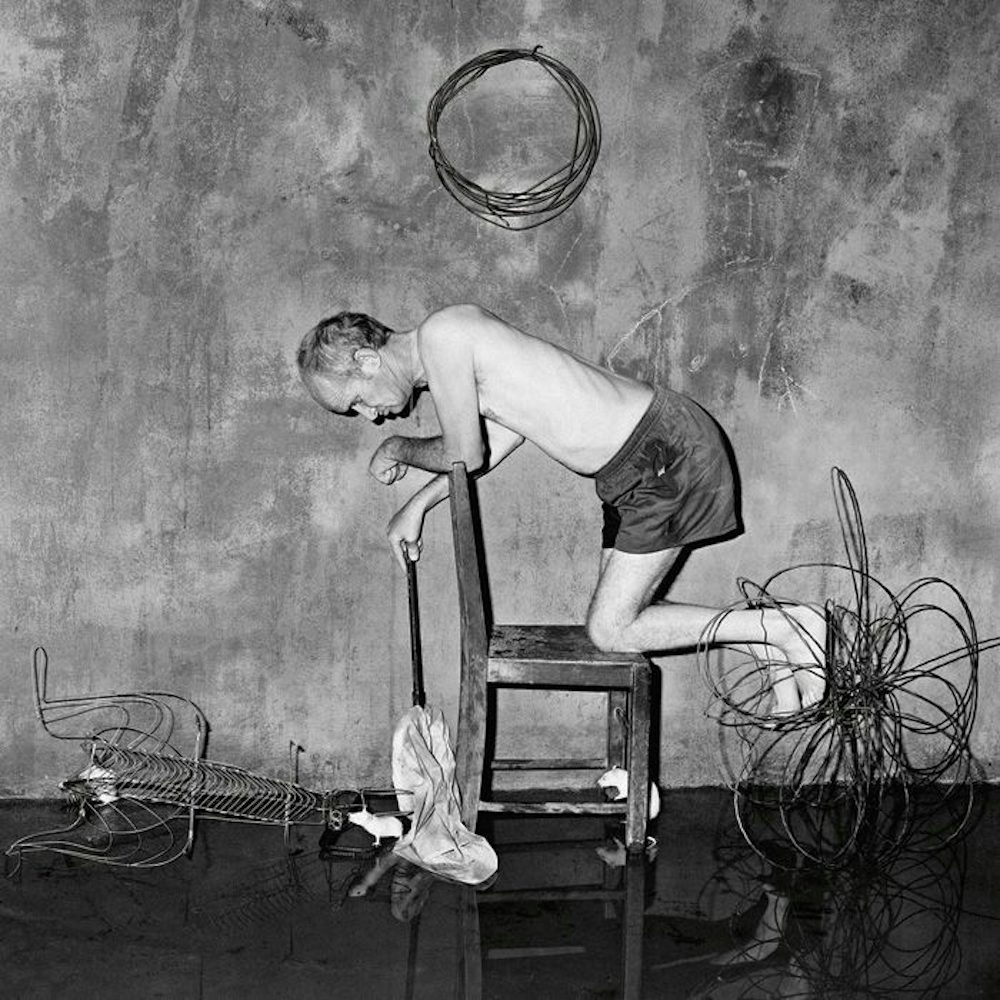

RB: No, I don't think it really had anything to do with too much about America. In fact, at the time when I moved here, I was sort of not really comfortable in the States. You know, I went to University of California, Berkeley in the late 60s, early 70s, during the counterculture. There was a lot of anti-Vietnam and anti-establishment type of thinking. I think I was sort of alienated from America. And then I made these long trips – I hitchhiked from Cairo to Cape Town in 74, then I hitchhiked from Istanbul to New Guinea two years after that, did my first photo book, and then went back to America and did this PhD in geology. But, I think I came back here probably for two or three reasons. One, it was a great place to work and as a geologist, it was a very wealthy country with a lot of potential here, so it was a great environment. Secondly, I married a South African woman.
And thirdly, even though they had it apartheid, I'd like this sort of – and this doesn't exist in the United States – I liked the relationship between this sort of more so-called third world, the first world, and the colonial world. Those dynamics don't really exist in the United States. And now it's really an African country in all ways, many, many ways. It's not like America. This is not America here.
PM: Yeah.Yeah, that's true.
RB: It was more of a British colony than an American one. If you had to say what is it more like, it was more like a British colony in the beginning than something out of a...
PM: Yeah, no, certainly. I did grow up in Little England, where I lived at the time. For me, it's probably more to do with the actual landscape and the small towns and stuff. But I just wanted to quickly ask you about the counterculture issue. Do you think that you remain part of the counterculture?
RB: Look, there are a lot of things that counterculture influenced me in a lot of ways. It made me feel like the individual rather than the group or the country was more important. It was something that I had...it was a period when you were sort of trying to figure out who you were. It was very much a psychological journey about the culture we're living in, as well as a psychological journey about the self. And my first degree was in psychology. This was something that did have a big influence on me. There were a lot of other influences on me, but I think it did. I think I had a very good education in high school from 14 to 18. I read endless books. And also in college, I have
excellent education. When I started working as an artist and doing other things in my life, I was really well endowed with a very good education from science to literature to theater, psychology. And that, I think, laid the foundations for a lot of what I do. Just as a small point, my mother started one of the first photo galleries in the United States and worked for Magnum. So, as a child, I got to know all the famous photographers in the world, so you represented them. This had the most influence on me in terms of being a photographer. So, by the time I was 17 or 18, I could take good pictures.
PM: Did you actually meet them, the photographers? Wow!
RB: Yeah, all of them. I mean, my mother was the first person to work with Gutej as a gallery in America. Cartier-Bresson, Marc Ravoux, Bruce Davidson, Elliot Irwin. All the people that were famous at the time. My mother was involved with them one way or another. I mean, they weren't her best friends and they weren't interested in me. But I did meet with them and I saw them and they gave my mother pictures and books, all these books and pictures all over the house. And my mother was passionate about it.
Then I, just by looking at the stuff, got to understand what the best photography at the time was. And so when I went out and tried to emulate them, I was on another level, because I was looking at this stuff for five, 10 years before I went out and tried to take my own pictures.
PM: So I was going to ask you to what extent do you think you were influenced by those photographers? You've clearly answered that, but I do want to ask you to what extent you have also been influenced by fine art movements like Dadaism and outsiderism and, you know, Art Brut, and so on? Are those things that just kind of happened organically in your work or are they references?
RB: Well, I think, initially they didn't have that much influence on me because I didn't study art. I had no background in art. I wasn't that interested in art. So, you know, I don't think it had a huge impact on me. So later on, you know, when I started to find my own path and maybe some way, one way or another, there were references, you could say that the wires in the pictures could have something to do with Monroe, some of the existential angst in the pictures of something new, Bacon. And I, and I like, I like seeing cave paintings. So, you know, all these things had some sort of impact, but they're all mixed up in your mind. And then, you have...you see all this stuff, but then you go out and take a picture and try to take a picture. And then it's meaningless. It doesn't, you know, where, where did this picture come from? Did it come from Bacon? Did it come from the place? Did it come from the rat?
Where did it come from? How did you do these things? The way it came from is like layers, like geology, layer on layer, layer, layer, layer, layer of work, years and years of hard work, passion, commitment, and probably a brain for it. So that's where it came from. It was built on my own journey over decades. That's where it came from.
PM: I've always been fascinated by the fact that you're a geologist and I think also a mineral economist. For me, it's kind of like an obvious allegory of layers and time and so on. But what led you from psychology to geology?
RB: I think the thing is, I didn't really want to work at all as a psychologist. That psychology thing was part of the counterculture phenomenon of getting to know yourself. But when I finished that degree, I really wasn't interested in working as a psychologist. I had no interest in it. I like the outdoors. I like to travel. I like nature. So I thought geology was the good profession to do that with.
PM: Over the years, your method has kind of shifted. I mean, I don't think it's changed. I still see you as essentially the same artist as working within the same kind of register. But was there a specific moment when you realised that you were moving away from pure documentary and toward more kind of fictionalised or constructed images?
RB: I think around ’97, ’98. So, Platteland, which was a very famous project, was really a documentary. Even though you could see parts of my style in that, it was still somewhat documentary. Outland was the next project. That was a five-year project between 95 and 2000. Beginning in 95, all my pictures to the present are in and around Johannesburg. And I started somewhere around 97 or so, started to work almost like a theater director. started to change the background, change the foreground, tell somebody to bring their pet rat in or do this or do that. Or maybe I made a scribble on the wall with wires. I used to work with wires. Before, there was a lot of drawing in the pictures I used to draw. In Outland, you can see almost all the pictures have wires in them. And wires were almost like a way of drawing. And so, somewhere around 97, 98, I started to take control of the situation, of the aesthetic, and started to build on my own impulses, rather than necessarily trying to make a statement about the people, the place, the culture, and all these things. Then it sort of became my head space and that was about 1997. And so, if you look at the Outland book, you'll see that the early ones feel a little bit like Platteland and the later ones feel a little bit more like the Ballenesque.
PM: So, I remember at the time, you know, some people kind of critiqued that. And I don't think they recognised the extent to which you were happy to have that seem intentional, you know, as part of the work. But, some people said that it was constructed and because it was constructed, because you'd interfered in an image, it was somehow inauthentic. Which I think is a very false logic. But my question is, was your move towards more and more assemblies, more interference – not interference, that's not the right word – but was your move towards greater degrees of assembly in any way a response to your critics or was it just something you would have done anyway?
RB: It would happen, layer by layer by layer. And so, you know, it wasn't...I think the only thing that...the main change for me, during this period beginning about 2000, the human face started to disappear. And one of the reasons the human face started to disappear was when people look at a photograph, it's like when you see a person, the first thing you do is you look at their face, you don't look at their shoes. So the face became an impediment to the formal qualities of my work. Nobody has to...they weren't worried about the wire, the background, the foreground. Is that person poor? Did you get permission? What did he think? Did you give him the picture? So you get those types of comments. And there was much more complexity in the work than the person. So once that face went away, they don't ask those kinds of questions. It becomes a more complex ambiguity for people to recognise. And I think when people criticise the work, whether it was in the Platteland series, the documentary period, or later on, usually the more they criticise it, the more it has affected their state of being, the more it's like a defense mechanism. So in fact, they're really projecting their own anxieties, internal anxieties, on me, because they can't contend with the issues that the pictures bring up, whether it's conscious issues or subconscious issues. So the more they struggle, as far as I'm concerned, the more the noose gets tighter around their neck.
PM: Yeah. So I spent a bit of time reading some of those reviews this weekend. And it was really interesting because, specifically one review, they kind of said maybe it's exploitative, but actually it's not exploitative because he does engage with his subject. And they're not just pieces of furniture. But then in terms of representation, it feels exploitative. And I could just feel this person just kind of, you know, wrapping themselves in their own words, because they couldn't get past that discomfort that they feel with people who are not...
RB: They're ideologically rigid, and the pictures attack their subconscious state of being, and they can't handle that. That's it. It's as clear as...I've been doing this for like decades. I know all the issues – I've been dealing with this for like so many years. So I know how to deal with it. I mean, it's clear. It's projecting their state of internal anxiety. That's all it is. And it shows their rigid ego.
I'm not saying, and you can't...and you can't...I mean, today, just today, I got like 10 messages from people from Outland wishing my wife a happy Mother's Day. So what are you talking about that I'm doing this or that to these people? These are my best friends here.
And I help a lot of people. Don't think I just don't sit and take pictures. I've helped hundreds and hundreds of people in my life. So you're telling me that I'm exploiting somebody's calling me up to wish my wife happy Mother's Day. You must be out of your mind.
PM: Yeah. For me, I don't know you very well, but getting to know you a little bit a long time ago, it was very evident that you were not separate from the world that you were photographing, you know, even if you're economically separate.
RB: You can't do things like this. You know, those places are...you come from here, these places are dangerous. They're not...people are having problems with their lives, and unstable. They have no money. And there I'm sitting, with a car and a camera going there with...I'm not a world karate champion. I'm not carrying an AK-47. And I'm in the place where 50, 60 people are hungry,
and having difficult lives, with a camera and taking pictures. And doing this for year after year. You can't do this unless there's a trust there. You can't do it. You will be killed. You come from here, you know the problems. It's evident, it's evident, it's evident. A lot of people call me uncle and father, by the way.
PM: Yeah, yeah. I mean, I think either middle-class critics or those middle-class people can get very confused about agency. And I often felt that their critiques of your work were far more condescending to your subjects than they were accusing you of being. Because it presumes that only middle-class people have agency and autonomy.
RB: A lot of it has to do with the political ideology more than anything else. I mean, the people I take the pictures of love the photographs. So they love the pictures. What's wrong with that? You don't like it? Somebody thinks negatively of them. The people who got the picture love the picture and put it next to their bed and thank me profusely. So, you know, the whole thing is full of garbage.
Look at the TV, look at every day in the newspaper, what they're showing. What are you talking about? And what did you eat tonight? Did you kill something? What are you doing with your car? You're polluting the environment. You're a big hypocrite.
PM: Yeah, I think it's interesting that people don't make the same critiques of Hollywood films in the same way. I was thinking of David Lynch.
RB: They worship...you're making a very good point. All over the world, it's part of human biology to worship celebrity, more deeply than you think. You can see that on Instagram – one of the most interesting things about Instagram, you scroll through it, when the movie star comes up or the great athlete comes up, they get hundreds of thousands of likes. It could be the most stupid photograph you've ever seen, but boy, they get hundreds of thousands of likes.
That's the way the human brain is structured. And it's not so simple to just say, stupid Hollywood. It's everywhere. Everywhere in the world, I've seen this. And sometimes I'm a celebrity. I can see it when I go to certain places. I'm like a celebrity. And people can't wait to have their picture taken with me. It's part of human nature.
PM: Yeah, I totally. get it. Back to the images themselves – I'm fascinated by mark making, you know, beyond your work. It's just these little messages that are, especially Durban, you know, in back alleys, on the side of bridges, just these often incredibly beautiful images. And it's a technique that traverses fine art across the spectrum, but it does have a particular resonance in marginal spaces.
So can we just talk a little bit about what attracted you to this kind of strange subconscious language that you've kind of incorporated into your work?
RB: Yeah, I guess it's the subconscious mind writing. It's like a cave painting, you know. It's like the subconscious mind, somehow or other exposing itself. I don't know.
What's interesting for me personally is that my drawings now and the way I draw look now like the same thing I did when I was five years old. So it's a very deep expression, a mental way of how the brain works with the hand and the eye. This is a ‘Roger Mark’. It didn't advance in a lot of ways to become like a Picasso Mark. It stayed the same for 70 years.
PM: Yeah!
RB: And this is what's interesting to me, and what's equally interesting, which is very important, in the photographs, sometimes the drawings are all mine. Sometimes they're all one other person, sometimes there are 10 other people. Sometimes they were there already. And what is important is that the aesthetic of the drawing has to be a reflection of my aesthetic. I'm just writing something for an art group museum today about how you can't distinguish my drawings from somebody else's on the wall. There has to be that coherence. And if there wasn't that coherence, the pictures wouldn't work. If Picasso drew the drawings on the wall, the photographs wouldn't work. There's a harmony between the drawings and the other things in the picture.
PM: Yeah. What I find so interesting about that very specific language is that, beyond the kind of signifiers, beyond the actual content, that the style of that kind of quick drawing seems almost universal – obviously when people are trained it starts to fade – but it does seem like a human kind of language that transcends actual language.
RB: Yeah. It's like a cave drawing, a child's drawing, something like this. It's a fundamental way of expressing one's self. It's a primal way of expressing one's self. And yeah, you're right, I think you're right. And then the challenge is then to integrate the act of drawing with the act of photography.
PM: So, you speak about how you are taking self-portraits of yourself, in a sense. All of your photographs are pictures of Roger Ballen. I do get that. I think that, in a sense, is true of every photographer; it's just that sometimes, we reveal less or more of ourselves. But my question is: to what extent do you think that you are also exploring a universal subconscious, rather than just your own?
RB: Well, again, this is a very, very complicated issue, the issue of archetypes. What's an archetype? What's social? What's primal? I've been thinking about this for a long time. And so, I guess the only issue would be that...it goes back to your first question, you know, like something that sticks, and sticks for a time.
And then if the art has an ability to stick for a time, and that the person viewing the picture has no idea who you are, where the picture was taken, but somehow another walks away with the picture, then that picture might have an archetypal meaning to it.
I always bring up this one analogy, which I like to bring up. For many years when I took my pictures, I carried this very heavy – I think I couldn't do it anymore, I was younger – this heavy metal box with pictures in it; it was pretty heavy. So when I went through the Johannesburg airport and they put it through the x-ray machine, they couldn't see anything inside. When they opened up that box, the people at security went crazy when they saw those pictures. "That looks like a ghost. Where did you take that? This is strange. This is going to give me this". They didn't even know they were photographs. They had no background in photography. That was a very interesting confirmation that the pictures had some sort of archetypal meaning.
PM: Yeah, that is interesting. What role do you think empathy plays in your photographs? Both in terms of your own empathy. and also the empathy of the people viewing your images.
RB: Yeah, but empathy is on a lot of levels. I'm empathetic towards the rats in my pictures. I'm empathetic towards the relationship with birds to the human catastrophe that exists outside. So you have to have a passion, have empathy. I have empathy with the people I work with. You know, empathy plays some role,I guess – there are a lot of animals in my pictures.
And what's always interesting, I'll bring up this point because it is a very important point. And again, it has no criticism of yourself, but it's a common issue. The questions are always about the people. It's never about the animals. In the last 25 years, there are 10 times more animals in the pictures than there are human beings. What about the birds? What do they think? Who are the birds? Why are they there? What is the relationship with them and me? What about the rats? Why do you hate the rats so much? What's wrong with the rats? What's your problem?
But this never comes up. It never comes up.
PM: I'm Yeah. Well, it actually really was legitimately my next question! (laughs)
RB: It's so interesting though. You see this in Johannesburg: "Lion bites toe of baby!" – It's all over the city. There's nothing about "50 lions were shot from hunters from Germany and Americans sent home in a packet."
PM: Yeah! you threw me a little bit there. But can we talk a little bit more about the animals and their consciousness?
RB: I like them. Yes, let's talk about them.
PM: Yeah, and also just about that disconnect between humans and animals, but also our relatedness. On some level, we can't, you know, engage with each other, but I do think our consciousnesses can intersect with each other, especially animals that we kind of know well, you know, if they are friends or, you know, semi-wild or whatever. How different do you think we really are from animals and also from each other?
RB: Look, most people in Western cultures judge the relationship between human and animals in the experience they have with their dog or their cat. They're totally alienated from nature and the real ultimate relationship, through evolutionary relationship and current relationship of nature to humanity.
So, you know, they're sitting and sending a dog to a psychologist for a thousand dollars an hour, and feeding it steak, and falling in love with the dog, and having the dog die, or the rat dies, having a psychological breakdown.
But the relationship is basically unharmonious. It's exploitative. It's destructive. It's clear. It's clear. And this comes...it's genetic....It's a genetic problem. It's not a cultural problem. It's a genetic problem that started thousands of years ago, because of the genetics of the human species and its need to survive. So we're not looking at something necessarily so cultural. There are obviously cultural aspects, some places may be more destructive than others, because they can control certain things. But it's a human nature problem that pervades the planet. I don't think there's any solution.


PM: Yeah, I mean, we've been doing it from the beginning,killing and burning everything our way as we...
RB: But with technology, you know, it's sped everything up. Before technology, the impact was less, but it's technology and overpopulation. You know, when there were a million people on the planet, it didn't have much of an impact. There was no electricity, no cars, no nothing. Cut down a few trees and they, you know, picked a few... and shot and speared a few rabbits or something. But, you know, this is an exponential problem.
PM: Yeah, yeah. I mean, what happened in the 20th century is appalling. It really is an atrocity, what we've done and what we're doing.
RB: There's no way out of it. My exhibition in my museum is called The End of the Game. It's been there for a few years, but I get this question all the time. It's a whole exhibition about the destruction...the human-animal relationship and the destruction of nature in a psychological way. So my only solution is to have more parks. It's the only solution I have.
PM: Yeah, in one of my other interviews, I spoke to one of the world's leading ecologists, and that's also his solution: massive amounts of parks and reserves, and we need to pull back a little bit. But there is no...as you say, it's part of who we are. And if it wasn't, people would be asking you about the animals in your photographs. We're obviously very human centered.
RB: No, you're right, there's no solution. Everything on the planet is there to survive and, by working with other people in your same species, as groups, that helps us survive. So it's something to do with brain structure, evolution, survival, all these things. It's not just a matter of, you know, some company, Apple computers, figuring out how to make a computer that disintegrates after you finish with it.
PM: So, I do think that, outside of all of that, that we can still relate to animals, that we can share some moments of consciousness. And I'm talking about, like, in the wild and in cities, you know, occasionally I'll be walking home and I'll see a fox, and that fox will look at me, and we'll walk, you know, for like a few hundred meters together. I mean, I understand that I'm at a certain distance, I get the fact that he's not going to be my friend, much as I might like him to be. But there is a brief moment of solidarity and I've experienced that with other animals. Maybe it's in my head, but I think that there is, that our consciousnesses can kind of touch against each other.
RB: Can be. I mean, there's so many different types of experience. The bottom line is it's hard enough to put your mind into your best friend's head, your parents, but you can't put your mind into the fox's head. Don't know what, going through the mind; he doesn't speak to you. So it could be that you had a hamburger at McDonald's an hour earlier and he smells the hamburger grease. I don't know, I can't judge anything, I can't judge.
PM: Yeah.
RB: They're on another sensory plane. I can't make any comments.
PM: Yeah, the one thing that for me is just kind of quite interesting or revelatory is the fact that, in the wild animals, can have relationships across species. That is something that does kind of happen on occasion.
RB: Probably for evolutionary reasons, though, for survival reasons. I mean, the lion doesn't have a good relationship with the zebra. The zebra has a good relationship with the wildebeest. So the wildebeest and the zebra get together for reasons of survival. They wouldn't get together with the lion.
PM: Yeah, totally. That is certainly true. Just on this, I have this quote from you. I don't actually have a question, but I just really like it. "I am fascinated by birds. They link the heavens to the earth."
They are just the most extraordinary thing. I love birds.
RB: Me too. That's what I said. People ask me, what would I like to be in my next life? I say "A bird, definitely". I don't have to go on an airplane ever again. I can fly, look down and find a nice spot, if I don't get shot. That's what I want to be. I want to be a bird.
PM: So, I don't know this is my empathy or if this is the construction of my brain – I am very problematically empathetic – but I have this experience where I can watch a bird take off – like a hawk, or even just a crow, or whatever – just take off and fly and across the sky. And I look at it and I get a real sense, just a small sense but a real sense, of the experience that that bird is having.
And that's an amazing biochemical thing for me to experience. I would love to be a bird...
RB: Well, look at the Greek myths, you know, Icarus, who tried to fly to the sun. It's a ghostly mythology about human beings wanting to be a bird. And unfortunately, most of us are so alienated from nature, that all we think about is what type of seat can we get on the plane that would be comfortable?
PM: Yeah. So like, this question could be very judgmental, but it's not. Do you eat meat? I don't know that.
RB: I eat meat. Yeah.
PM: I just wanted to know, I'm just interested.
RB: Well, I eat meat. I don't hunt, but I eat meat. And I'm as destructive as everybody else.
PM: Yeah, I mean, me too, lastly, there are areas in which I try to...
RB: So, say that you don't eat meat. I'm not complaining. I'm not trying to make any value judgments. But now you say you eat only vegetables. But what did they do to the forest to make the vegetables? They killed everything in the forest and planted, put fertilisers on it. There's no plants living in there. Everything's dead so you can have some vegetables. So the vegetables also are responsible for the destruction of nature.
PM: Yeah. Yeah, totally. So I've actually worked for a vegan organisation for the last few years and I've had this discussion about the fact there's no such thing as real vegan farming, you know, unless you're basically a Jainist and growing everything completely by hand and making sure you don't kill the earthworms. But industrial plant farming is truly destructive. Lots of small animals die, they get chowed up by...
RB: No, there's no more land. Fly over Europe. Go fly over Germany. Fly over most of these places. There's hardly anything wild. It's all farming or cities. maybe, and where you see unspoiled areas, it's either a park or a timber plantation.
PM: Yeah. So back to your actual photographs.
RB: Yay!
PM: So it struck me – and it's interesting that it took me so long to notice this – but I suddenly realised that nearly all of your work from the last few decades takes place indoors in the houses and interiors. You never shoot exteriors. Is that correct?
RB: You're 100 % right. Almost nothing since... I'll give you an interesting story. There was a place called Hope Town in the Free State. And I remember knocking on the door of this place, and the guy let me in. And then I went in, I started taking... he had interesting things on the wall, the wires, the drawings, and a few other things. So then, when I went in there, physically, I went in there psychologically. And I never went out again. I never went into that other place. Everything was part of an internal claustrophobic, confined, intense space. And it happened during the Dorps period. And there were some other pictures outside after that, but from 1995, I don't think there's even one picture outside.
PM: Yeah, that's very interesting. So, do you think that we're always trapped in some sense by all the rooms in our head?
RB: Yeah, we are. There's the famous Sartre play, No Exit. There is no exit.
PM: Yeah, yeah. So I'm very interested in how we map the physical spaces we live in onto the neurological spaces in our brain, and how we basically live in those mental spaces more than we do the physical ones. My mother just...
RB: The physical is the product of the mental, that's all. There's no mental, there's no physical.
PM: Yeah. My mother has just...my father died last year, my mother's moved in with my sister. And she had to leave her house. And it's better for her to live with my sister, but the trauma of no longer having that mental space that she used to live in for, you know, 10 years, has had a really big impact on her, on her mental life. It's hard.
RB: I can imagine. But an animal is the same way, you know. If you change the dog's bed or put him in another room, even a rat, they get very insecure for a while. Put a rat in another cage and you'll see how insecure it gets for a while, until it sorts its place out. It's a very common problem. Even when you go from one hotel to the next hotel in another city, you're insecure before you're up in the room.
PM: I recently moved to a much nicer apartment. I was living in a basement apartment before, so it was totally a good move. But my brain was literally traumatised for a few months. It just couldn't cope with what had happened.
RB: Enough. (laughs)
PM: Yeah. So, there's one other question that I would like to ask you about houses. And this, you know, relates very much to Spirits and Spaces. Houses are lots of things and rooms are lots of things, but one thing that houses are, are places where families live. So your work is obviously Jungian. But I want to ask you, to what extent are these images, you know, populated by personal collective Freudian ghosts? Is there an implicit family history in the images at all? Or is it independent of that?
RB: I'm a little bit unclear, Peter, of the question.
PM: Yeah, that's because it was kind of all over the place! Basically, are there there Freudian stories going on in your work? Are there stories about family, about mother, father? I mean, I don't think so, but it's just something that came to me that I wanted to ask you.
RB: No, I don't think so. I don't think so. I think these are all like more deeper existential issues, you know. For example, the chaos. I think you see a lot of the...chaos is one of the...it's a real existential issue. You don't know how you're gonna sleep tonight. You don't know what's gonna come together, what's gonna fall apart. So your relationship to time, to your own identity and who you are and what you are, or why you are, in a very nonverbal way, I think. And, you know, obviously, my experience of life is starting with my mother and father. We all have some relationship, everything relates to everything else, but I don't know what's in the foreground, what's in the background. And I'm working in a nonverbal... you have to understand when I make these pictures, it's truly in a nonverbal way. If I can decipher the meanings in words, then I see it as a bad picture. It's too obvious. So the links have to be non-verbal. And if they're non-verbal, all the issues that we bring up are very difficult to put into any real...
PM: ...structure...
RB: ...identity...or structure. I can't, I can't. It's a common comment I always make: if I can define the work in words other than "enigmatic", it's a bad picture. It doesn't challenge me. I understand it already – I might as well not do it. I might as well not do it. I might as well just go take a picture of the sunset somewhere. So you're right. I can't. So it's too hard. The brain is so complicated and so difficult. And I'm trying to deal with the difficulties rather than the obvious things. There's no point doing the obvious things. Time's too short.
PM: Yeah, and I do think that we can perhaps resolve our family histories, but we can't resolve the mess that lies beneath our subconscious, because it doesn't even exist in terms of resolution.
RB: No, you can't resolve it. You can try to define it for yourself in various ways, bring it forth, but you won't find many answers.
PM: Okay.
RB: There are greater forces out there that don't have...that are undefinable.
PM: So possibly, I'm moving in that direction with this question – and this is something that I'm very interested in myself – but you write and talk about spirits. For me, there is an animism in your work, an aliveness in even the dead and inanimate objects. And that may well have more to do with me than other viewers. But do yousee the world in terms of animism? And what do you think of the notion of pan-psychism, that we live in a kind of world that is, on some level, alive.
RB: Well, basically, animism starts at the afterlife. So animism is so much about where you came from and what happens later. So it is pervasive in every religion. It's pervasive in everybody's mental state because you're going to die. You know, you're going to die. What's going to happen to you? So it's a way of trying to come to terms with the afterlife. That's all it is.
PM: For me it's very telling that every single culture seems to present like the animals and the trees and the sun and everything as having agency and being alive.
RB: Oh, that's what you mean. I didn't understand it. Oh yeah, you're right. It has a real Buddhist concept to it. It's true. You're right. It's everywhere. I mean, I would say that I'm Jewish by birth and culture, but I'm a pantheist by nature, believing in God as a nature.
PM: Yeah, yeah.
RB: That's what I believe. That's why I'm concerned about the environment, I'm concerned with dealing with this human-animal issue. And so this pervades my thinking all the time, and it's a deep-rooted view of the world and view of my relationship with nature and everything else. So that's what, I think probably more than anything else, concerns me is the destruction of the natural world. I think that's probably…so when you look at the animals and try and…the animals in the picture…there's a reflection of a deeper concern. It's not an obvious…it's dealing with something about the human nature in different ways and the animal nature in different ways, and trying to come to terms with that. And hopefully that discontinuity has a sticking power in people's heads. I know when they come to my museum, it sticks. They're not walking out of here laughing, I can tell you that. They're not even criticising.
They're walking out of here with that. I got them in the stomach. And I'm not putting a knife in their stomach either. It's through artwork, documentation, films. And it's done in a subtle way. It's not just putting a dead animal on the floor or something. It's done in a subtle way.
PM: Yeah. So, there's something else for me. I don't think I've seen this word in the writing about your work – but the more I look at your images – and I'm thinking of the recent work and also images that I've seen countless times over decades, the more I look at the more tender they are. There's literally a softness and openness of vulnerability that I think a lot of people don't see.
RB: I think you're right. And it's also the absurdity and the humor in the pictures. I think that that's one thing that's very important, one way of looking at the picture, because life is absurd in an existential way. And I think most of the pictures have this humor, a fundamental humor of absurdity in the picture. So, I think this pervades the work, because, I don't know where that came from, whether it came from reading Camus or this one or that one, or coming to terms with it myself, or a relationship to surrealism or art brut or something, the pictures do have humour in them. And there's a dark humour, if you want to call it that. And it pervades the work. It's a very important point of view.
PM: Yeah, I agree. And I see it. Roger, I have more questions, but I think I should leave them. I think we should bring this conversation to a close, once more. But it's been a real pleasure talking to you.
RB: It's also a great pleasure talking with you. You have really great questions, and our conversation is really fluid and enjoyable. And. are you planning any future trips to Johannesburg?
PM: Well, I'm in Berlin for now, but I do need to come back to South Africa at some point soon to see my family and Joerg and Durban. I haven't been to Durban for a long time.
RB: And I have a show in Berlin at Fotografiska in November, so maybe we can see each other then.
PM: Oh, excellent. That'd be wonderful. I'll definitely see you then.
RB: I think it's the fifth or sixth of November. So put a little X there!
PM: Cool, I'll do that. The fifth of November is a good date. Thank you so much for talking to me.
RB: No, thank you. I really appreciate it. And it's really great speaking to you, and I’ve really enjoyed every minute of our conversation. And yeah, you did a great job.
PM: Thank you so much, Roger. I really appreciate that!
RB: No, thank you!


